
Stephanie’s project on identifying and advancing microbial candidates suitable for insecticidal product development
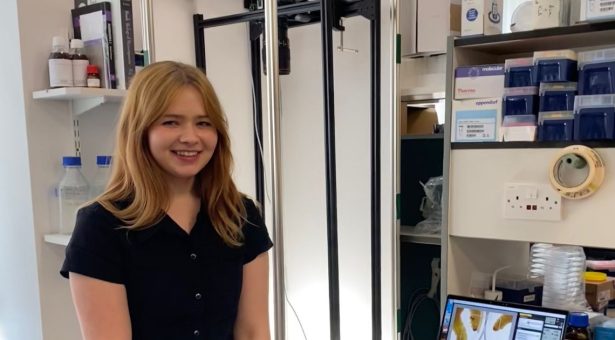
Stephanie Little, a second-year John Innes Centre (JIC) student has just completed her PIPS with BugBiome, an agri-biotech start-up reinventing pest control based at Norwich Research Park.
BugBiome is on a mission to create safer pest control solutions by harnessing natural microbiomes through their high-throughput screening platform. In July 2026, they secured a 24-month grant from Innovate UK to fund a collaborative project with JIC, Harper Adams University and Applied Insect Science to develop a new biological insecticide to control cabbage stem flea beetles (CSFB) in oilseed rape.
With her PIPS, Stephanie wanted to gain a greater understanding of what it would be like to work within the biotech industry whilst also being able to expand her scientific knowledge on sustainable agriculture. BugBiome was a perfect match. Two of her goals were to better understand the basics on entomology and the modes of actions of in which insecticides work plus understand the mechanisms of how a high-throughput insect behavioural screening platform could characterise specific insect responses to different insecticide treatments.
Her PIPS project centred on identifying and advancing microbial candidates suitable for inactivated (non-viable) insecticidal product development, a key commercial and regulatory pathway for BugBiome. Her main responsibility was to generate videos of insect larva for use in a video-based behavioural analysis pipeline. When putting her videos through this pipeline, it tested the robustness and accuracy of the analysis tool. She generated a library of videos of insect larvae which had been subjected to various treatments and was able to thoroughly test the video-based behavioural analysis pipeline.
She helped with other insect assays: gathered resources; supported troubleshooting setups which tested her creativity and problem-solving; applied insecticidal treatments; and scored insect mortality. There was also the day-to-day insect husbandry, looking after wax moths, pea weevils and collecting these from the field. Learning how to safely care for different insect species was key.
Several transferrable skills were development during the internship: videography (which she will use in her own luciferase-reporter timeseries imaging assays), communication and presentation skills, computing coding skills (from using PowerShell ISE and Python scripts), time management and teamwork. Stephanie appreciated the support she received from the close-knit, collaborative BugBiome team
Chris Mosedale, Stephanie’s supervisor and co-founder and Chief Technology Officer at BugBiome said, “Having Steph on board is a great opportunity for us to progress projects that we think have merit and require a fresh pair of eyes to take over and improve, while also providing training and the chance to bring new skills into the company.”
Stephanie’s advice to other students is, “start looking for possible PIPS placements as soon as possible so you have time to decide which project/location/timing best suits you. If the project is lab-based, then ensure to work with organisms you do not currently work with. PIPS is a great opportunity to learn a different branch of skills to your own PhD project and broaden your horizons.”