
Phoebe’s experience with commercial strawberry trials at Dyson Farming
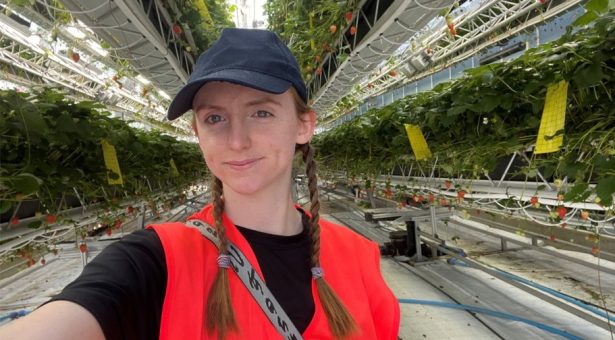
Phoebe Elvin completed her three-month professional internship for PhD students (PIPS) with Dyson Farming Research (DFR). Although her PhD focuses on wheat diseases, she chose to work on strawberries during her PIPS to broaden her plant science knowledge and gain experience of research within a large commercial agricultural company.
She was based primarily at the Carrington glasshouse, where she worked alongside the research team conducting commercial strawberry trials, including variety trials. This involved collecting and analysing data on fruit quality, including berry weight, size, sugar content (brix), plant growth, disease incidence, and overall yield. The research team used these data to inform decisions about which varieties may be suitable for future commercial production.
Alongside the variety trials, she carried out her own project investigating two important strawberry diseases, Botrytis and powdery mildew. The work supported the development of a new UVC-light treatment that could potentially improve fruit shelf life. This involved literature reviews, disease monitoring, measuring disease progression over time, and assessing how the technology could fit into commercial packing workflows.
One of the most valuable aspects of the placement was seeing how research is integrated into a large-scale commercial production system. Phoebe learnt about glasshouse crop management, irrigation, disease control strategies, pollination, automation, yield forecasting, and the challenges of balancing scientific research with commercial priorities.
The placement also provided opportunities to experience a wide range of agricultural innovation. Highlights included visiting the anaerobic digestion plant, learning about the different vertical growing systems for strawberries and potatoes, conducting crop monitoring activities, and attending the Dyson Farming Research launch event. These experiences gave her a broader understanding of modern agricultural systems and emerging technologies.
Throughout her PIPS, Phoebe developed skills in experimental design, data collection and analysis, literature review, project management, communication, and stakeholder engagement. She also gained experience communicating with researchers, growers, agronomists, engineers, managers, and external industry partners.
Overall, the placement provided an excellent opportunity to gain experience of research in a commercial agricultural setting and broaden Phoebe’s understanding of horticultural production and agricultural innovation.
Hannah Wileman, Phoebe’s supervisor whilst on her PIPS with Dyson Farming, said “Phoebe was a valued member of the team, she provided useful suggestions and inputs to improve our practices and worked hard to deliver the day to day data collection required. I believe she became more confident in working as part of a larger organisation. I also believe she developed a lot of knowledge about agriculture, that I hope will benefit her in the rest of her PhD programme and wider career.”
Phoebe’s advice to other students is, “do something that will give you a completely different experience of what science can be.”