
Lukasz’ PIPS tackles one of the most exciting and challenging questions in modern biology – what is the origin of life?
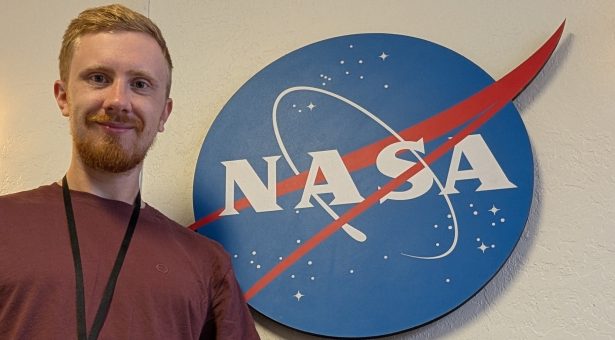
Lukasz Sitko, an Earlham Institute based student recently returned from NASA Ames Research Centre where his 12-week internship focused on understanding the role of amyloids and ribozymes in the earliest forms of life.
NASA’s Ames Research Center is one of ten NASA field centres that conducts world-class research in aeronautics, exploration technology and biological sciences.
Lukasz joined an interdisciplinary team of scientists from the NASA Ames Research Center and the Stanford Chemical and Systems Biology department. He has always been fascinated by space exploration and engineering and this internship was the perfect opportunity to explore how the skills acquired during his PhD could be applied to a scientific project at the space agency. During his internship Lukasz created and optimised computational simulations of in-vitro ribozyme evolution and tested the propensity for protein aggregation of a range of cyanobacterial proteins.
With these projects, he achieved all his set objectives and acknowledged how his skills in computational and wet-labs experiments developed besides gaining better understanding on how research is funded, managed and performed in the US institutions.
Tomasz Zajkowski, Lukasz’s supervisor at Ames said, “During his research stay at NASA Ames Research Center and Stanford University, Lukasz made a breakthrough discovery demonstrating that cyanobacteria—among the most ancient and evolutionarily conserved lineages on Earth—harbor prion-like protein domains capable of supporting protein-based inheritance. His work provided experimental evidence that prion-like mechanisms, widely associated in public perception with neurodegenerative disorders, represent deeply conserved and biologically functional molecular systems with ancient evolutionary origins.
This discovery significantly advances our understanding of non-genetic inheritance mechanisms and supports the view that prion-like protein assemblies may have played a fundamental role in early cellular evolution, long before the emergence of complex gene-centric regulatory systems.
We are sincerely grateful for Łukasz’s outstanding scientific contribution and its lasting impact on this research program.”
Lukasz commented on how fantastic his internship was and how grateful he is to NASA Ames Research Center, Stanford and Blue Marble Institute for Science for hosting him. His advice to students thinking about their PIPS is to start the process as early as possible, be patient and organised.