
Ella, Kestrel and Matthew support AfriPlantSci 2025
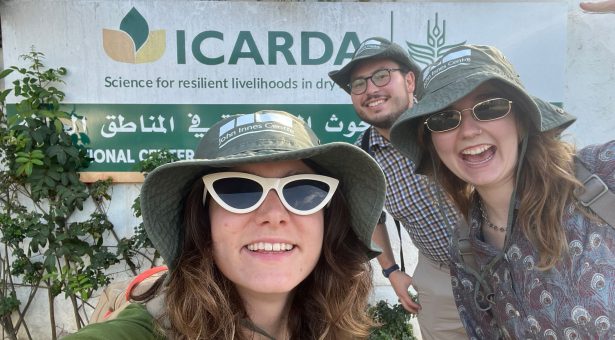
Ella Penny (JIC), Kestrel Maio (JIC) and Samuel Matthew Shackleton-Chavez (UEA) travelled to Rabat, Morocco for their PIPS where they contributed to the design and delivery of the AfriPlantSci 2025 international course on plant genome editing and scientific skills. Hosted by the International Center for Agricultural Research in the Dry Areas (ICARDA) in Rabat and University Mohammed VI Polytechnic (UM6P) in Ben Guerir near Marrakesh, the course was part of a larger UK Consultative Group on International Agricultural Research (CGIAR) and Foreign, Commonwealth and Development Office (FCDO) project to build plant science connections around the world.
The trio spent one month at JIC followed by two months in Morocco, hosted primarily in the capital Rabat. The placement was run by JIC, with Professors Diane Saunders and Cristóbal Uauy, as well as ICARDA. The three students learned new skills from the international researchers at ICARDA while preparing for the AfriPlantSci two-week course.
All three thoroughly enjoyed their time at ICARDA, which culminated in the AfriPlantSci 2025 course, where the students were able to create and teach sessions as diverse as science communication skills, responsible use of AI, plasmid design and assembly, applying to scientific conferences and how to give a scientific presentation. Ella, Kes and Matthew engaged with the 22 course participants who had travelled from Morocco, Egypt, Kenya, Pakistan and China, building connections and friendships during their time there.
While on their PIPS, they also had the opportunity to explore Morocco, taking weekend trips to Casablanca, Tangier, Fez, and with the AfriPlantSci course to Marrakesh. Each of the students tremendously enjoyed their placements, the skills they developed and career opportunities they gained.
Ella commented, “I loved the many varied opportunities this placement provided. As well as teaching (which I’d never done before), I was able to learn graphic design skills, conduct video interviews, edit audio/visual media, capture photos and B-roll with a professional camera and also helped on a separate bioinformatics project with one of the research associates at ICARDA. The variety allowed me to try many different things and realise I really enjoy working with people, whether leading sessions or helping someone feel comfortable during a video interview. The absolute highlight for me was working with the participants of the course. We were privileged to have a cohort of extremely hard-working and engaged individuals, who I immensely enjoyed teaching. I was able to learn much from them and they helped me build confidence leading sessions, especially interactive activities. The generosity and kindness I experienced whilst working in Morocco made for a really special placement.”
Kes said, “This placement really forced me to step outside of my comfort zone and I found both my skillset and confidence grew as a result. I had no previous experience developing courses or teaching, but I knew going into this placement that this was a skill I would really like to develop. I delivered three separate workshops on topics from ‘Travel Grant Writing’ to ‘Critically Evaluating Scientific Papers.’ Alongside this, and unexpectedly, I developed skills in photography and videography. We were coordinating with a separate company, Centre for Agricultural and Biosciences International (CABI) to develop a social media strategy, therefore we were tasked with collecting B-roll and photos of participants and trainers. This was a task I hadn’t expected to enjoy as much as I did, and it is a skill I hope to carry forward. Whilst at ICARDA, I also worked with Maryeme Benounou, the senior researcher in cactus breeding. This gave me new insight into the challenges and satisfaction associated with working with an under-researched crop and inspired me to think in new ways about my own PhD project. Overall, through this placement I have gained confidence, connections and friendships I hope to foster into the future.”
Matthew remarked, “During the placement I stepped out of my normal PhD topic, where I work with medflies and CRISPR-Cas9 genome editing. I enjoyed traveling to Morocco and learning new skills such as hands-on experiences with Prickly Pear Cacti, the local entomological pests the Hessian Fly and Russian White Aphid, as well as learning some R coding for a GWAS pipeline. I really enjoyed transferring my genome editing knowledge and technical skills into plant genome editing for the AfriPlantSci course, which expanded my overall genome editing knowledge and confidence in the subject. I also developed my interest in higher education teaching, and found the experiences in course design, delivery, evaluation and meeting participants absolutely wonderful. I am now working towards teaching as a career goal. I enjoyed the two months we had in Morocco as I was able to immerse myself in Arabic language learning, as well as explore Morocco. I had some incredible experiences all thanks to this PIPS placement and the wonderful opportunities it enabled.”
All three students thoroughly enjoyed their placement and offered this advice to other NRPDTP students about to organise their PIPS:
- Matthew noted, “Make the absolute most of this opportunity, to do something outside of your normal field of research, to travel fully funded by your hosts and DTP, and to try new things, I even did surfing lessons!”
- Kes spoke of, “Especially when travelling to a new country, there is a balance to be had, but try to make the most of every opportunity! The people we met were the highlight for me!”
- Ella shared two pieces of advice, “Push yourself to choose something that you have no experience in, and talk to as many people at your host organisation as possible, asking them about their work and how they got there!”
Maximillian Jones, their PIPS supervisor said, “all three students made strong, measurable contributions to our project and displayed high levels of autonomy. They executed their remits brilliantly, delivering highly engaging and valuable sessions that blended lecturing with practical group activities and interactive quizzes hosted via the platform Mentimeter. In addition to this, they each contributed to scientific projects at their secondary host institute (ICARDA Morocco) and collected photo and interview material for the course’s social media strategy, working closely with the communications teams from three institutes to do so. Overall, I cannot stress enough their enthusiasm, can-do attitude, and ability to explore and make progress even where little direct guidance was available or possible. The delivery of this flagship teaching course for JIC would not have been possible without them.”