
Libby Birkett and her EcoMetal team selected as YES2025 AgriTech finalist
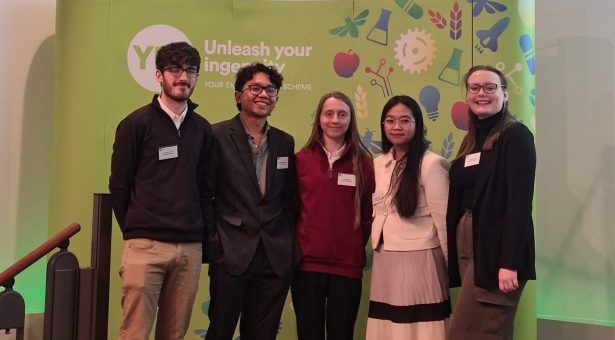
Libby Birkett, a PhD student based at the Quadram Institute, took part in the agriculture category of the Young Enterprise Scheme (YES) Competition as a member of a multidisciplinary team from Durham University, called EcoMetal. Their project addressed arsenic contamination in rice paddies, a major global issue affecting food safety and public health in regions where rice is a staple crop.
The aim of the YES competition is to develop an idea for a scientifically viable solution rather than a fully developed commercial product. Within this framework, Libby and her team proposed a conceptual bioremediation approach using bacterial lysates embedded in a cartridge-based system for use in flooded rice field environments. The concept was designed to reduce arsenic bioavailability in soil and water, thereby limiting uptake by rice plants and subsequent entry into the food chain. Emphasis was placed on scientific plausibility, mechanism, and potential real-world application.
Libby’s role involved contributing to experimental design, researching arsenic–microbe interactions, and helping to develop and refine the cartridge-based concept. She also supported evaluation of the proposed biochemical mechanisms underlying arsenic binding and removal, as well as assessing feasibility within agricultural constraints.
Throughout the competition, the team refined the idea through successive stages. They first pitched to Syngenta for the semi-final stage, where they received industry feedback to strengthen the scientific and practical aspects of their proposal. They then progressed to the final stage, presenting at the Royal Society, where they delivered their final pitch to expert judges.
The project was awarded Best Intellectual Property (Best IP), recognising the novelty and strength of their idea within the context of the competition. The experience also made Libby think differently about her own research, particularly in how early-stage scientific ideas can be framed for translation, and how important it is to consider feasibility, application, and communication alongside experimental detail.
Well done Libby.